Wedding Invitation Wording: When Is Black Tie Optional… Optional?
Few tiny words cause more collective group-chat panic than “black tie optional” on a wedding invitation. The moment it’s spotted, the questions start firing: “Is it actually optional?” “Do I need to rent a tux?” “Will I be underdressed in a suit?” “How fancy should my dress be?” As a couple, you probably added that word optional to ease the pressure, not send your guests spiraling over an outfit.
So let’s slow everything down. Black tie optional can be a beautiful middle ground between ultra-formal glamour and a more relaxed celebration—if it’s used thoughtfully and explained clearly. As stationers who live and breathe wedding invitations and dress codes, we’ve seen first-hand how a few well-chosen words on paper can calm nerves, set expectations, and create the exact atmosphere you’re dreaming of.
What Black Tie (And Black Tie Optional) Actually Means
Before deciding when black tie should be optional, it helps to understand what black tie itself really is. Black tie is one of the most formal dress codes short of white tie. Think of it as “evening elegance” with a clear structure:
For men:
A tuxedo (often black or midnight blue)
White dress shirt
Black bow tie
Black dress shoes
For women:
A floor-length gown or very formal cocktail dress
Elegant accessories and evening-appropriate shoes
Black tie is less about labels and more about a shared level of formality. When guests see black tie on a wedding invitation, they can assume you’re planning a polished, evening affair with a more elevated dress code.
Black tie optional lives in the space just below that. It means: We’d love to see tuxedos and formal gowns, but they are not required. In practice, black tie optional is a flexible dress code that gives your guests a choice between true black tie and their nicest, more traditional formalwear. The catch? Without clear guidance, that flexibility can feel like a guessing game.
When Black Tie Optional Makes the Most Sense
Black tie optional is not right for every wedding, but when it fits, it fits beautifully. It works best in that sweet spot where your event is undeniably formal—but your guest list is diverse in age, budget, and style.
You might consider black tie optional if:
Your venue is formal, but not stuffy.
Historic mansions, chic city hotels, rooftop ballrooms, and grand museums often call for a elevated dress code. If the chandeliers are sparkling and the cocktails are stirred, black tie or black tie optional is probably appropriate. Adding “optional” can soften the edge, especially if you know not everyone will own or want to rent a tux.
Your ceremony is in the evening.
While there are no absolute rules anymore, black tie and black tie optional both feel most at home for late afternoon or evening weddings. A 5:00 pm or later ceremony, followed by a candlelit reception, sets the stage perfectly for guests in tuxes, long dresses, and formal suits.
You love a glamorous aesthetic—but care deeply about comfort.
Maybe you dream of sweeping hemlines, satin lapels, and that timeless, cinematic feel to your wedding photos, yet you also don’t want your guests to feel pressured or financially stretched. Black tie optional lets you set the tone for elegance, while still giving everyone room to show up as their best, most comfortable selves.
Your guest list is a mix of style enthusiasts and minimalists.
Some of your guests will jump at any excuse to wear a tux or a full-length gown. Others may own just one good suit or feel more at ease in a refined cocktail dress. Using black tie optional allows both ends of that spectrum to coexist gracefully at the same celebration.
The Pros and Cons of Calling It Optional
Like all dress codes, black tie optional comes with trade-offs. The key is deciding whether those trade-offs match your vision.
Benefits of black tie optional:
You avoid alienating guests. Not everyone has access to black tie wedding attire, and not everyone is comfortable in it. Optional gives guests permission to elevate within their means and comfort zone without feeling excluded or judged.
You keep the atmosphere elevated. Even without a strict black tie requirement, most guests will still interpret this as “dress up.” Dark suits instead of casual blazers, gorgeous longer dresses instead of sundresses—that subtle difference is often all you need to shape the mood of the night.
You leave room for personality. Black tie can feel quite structured. Black tie optional leaves more space for individual style: a patterned tuxedo jacket, a jewel-toned gown, a sleek jumpsuit in an evening fabric. The mix often makes for more interesting, modern wedding photos.
Potential drawbacks:
You invite some ambiguity. “Optional” is inherently vague. Guests may worry about being the only one in a tux—or the only one not in one. Without extra clarity, you risk that awkward in-between where some are in full black tie and others are closer to cocktail.
Your photos may feel slightly less uniform. If your dream is a very classic, almost old-Hollywood look with every gentleman in a tux and every lady in a gown, black tie optional might dilute that effect. You’ll likely see a mix of tuxedos and formal suits, long gowns and cocktail dresses.
Neither of these drawbacks is a dealbreaker. They simply mean you’ll want to use your wedding invitation wording—and any companion pieces like your wedding website—to guide guests with a gentle but confident hand.
How to Clearly Communicate Black Tie Optional
This is where thoughtful paper goods and clear language become your best friend. Writing “Black Tie Optional” in tiny type in a corner of your invitation and hoping people figure it out is asking for confusion.
On the main invitation or details card, you might use language like:
“Black Tie Optional”
“Black Tie Preferred, Formal Attire Welcome”
“Formal Attire; Black Tie Optional”
Each of these phrases sends a slightly different message. “Black tie preferred” nudges guests toward tuxes and gowns but remains flexible. Simply “Black tie optional” sits more squarely in the middle. “Formal attire” is gentler, with “black tie optional” explicitly giving permission for either direction.
Your wedding website can be even more specific. This is your space to translate the dress code into real-world guidance:
“For gentlemen, a tuxedo or dark suit and tie are both perfect choices. For ladies, we suggest long gowns, dressy midis, or elevated cocktail dresses in rich, evening fabrics.”
You might even mention the venue and setting:
“Our celebration will be in a formal downtown ballroom, so think evening elegance—nothing too casual, but no need to stress about a tux if you’d rather wear your favorite suit.”
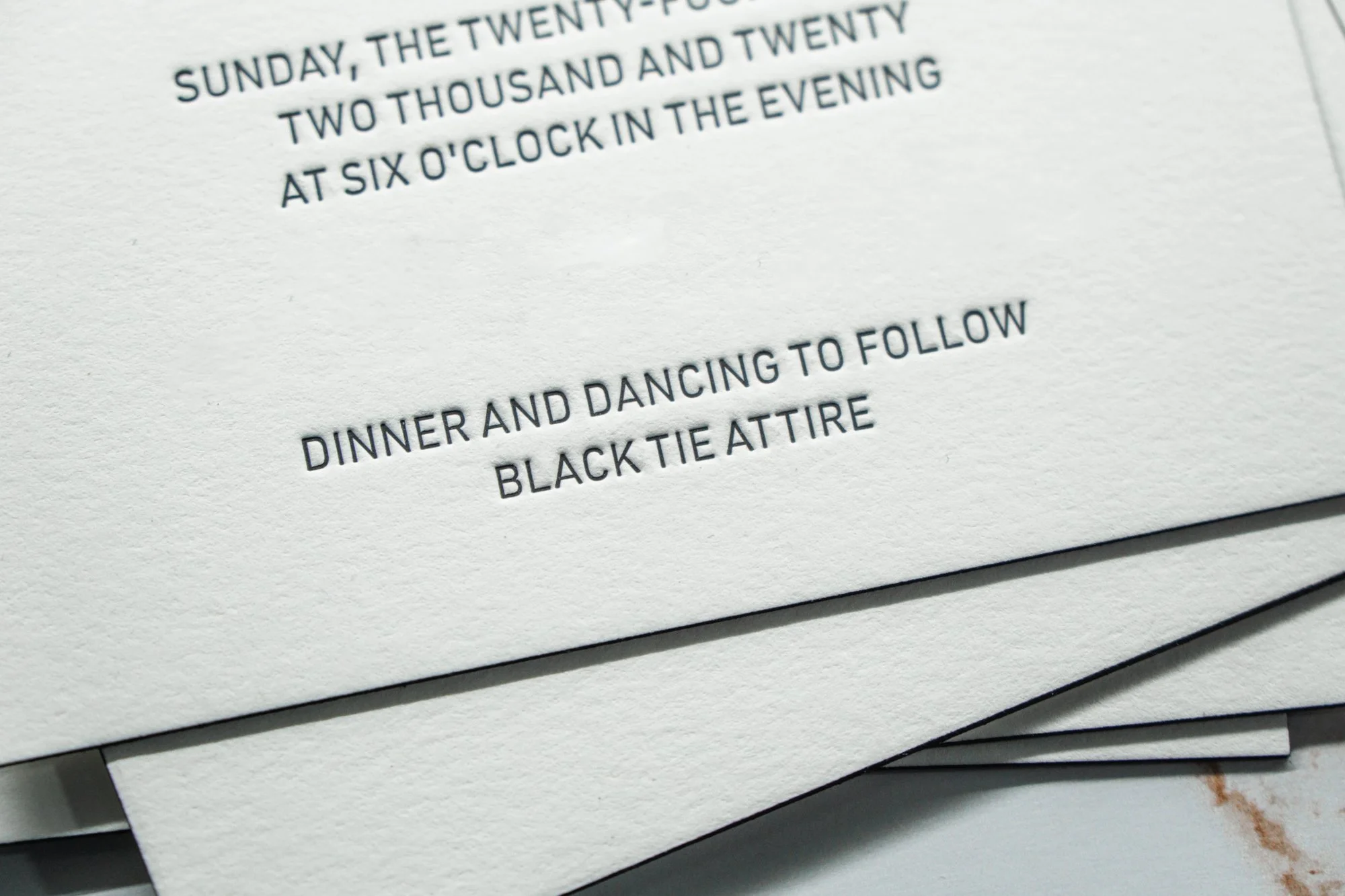
We often help couples fit a succinct version of this tone-setting language onto an enclosure card or the back of a details card. Luxurious, tactile stationery gives your words weight—literally and figuratively. When guests feel the impression of the letterpress and see your careful wording, they understand that you’ve thought of them, and that the dress code is part of a bigger, intentional experience.
What Guests Can Wear for Black Tie Optional
Of course, even with the right words, guests will still ask: “Okay, but what does that actually look like for me?” When you’re deciding whether black tie should be optional, it helps to picture what you want to see when you look out across your reception.
For men, black tie optional usually translates to:
A tuxedo, if they enjoy dressing to the nines.
Or a dark, well-fitted suit (navy, charcoal, or black), with a tie and polished dress shoes. The suit should feel more special than office wear—crisp shirt, elevated accessories, perhaps a pocket square. Think: “wedding formal,” not “work meeting.”
For women, black tie optional opens up several beautiful choices:
A floor-length gown in an elegant fabric.
A sophisticated midi dress or cocktail dress, as long as the fabric and styling feel evening-ready rather than casual.
A tailored jumpsuit with dressy details and refined shoes.
Color is largely up to individual taste and your wedding style. Jewel tones, deep neutrals, and metallics photograph beautifully for evening weddings. Guests can skip anything too casual: sundresses in light cotton, denim, flip flops, and overly relaxed silhouettes will feel out of place.
When you, as the couple, understand this spectrum of acceptable wedding attire, you can decide if that range matches what you envision. If yes, black tie optional is likely your sweet spot. If you’re craving a tighter, more uniform look, you might lean all the way into a pure black tie dress code instead.
Matching Your Dress Code to Your Stationery Story
Your wedding invitation is your guests’ first tangible glimpse into the world you’re creating. The paper, printing method, typography, and wording all whisper hints about the kind of evening you’re inviting them into.
If you’re leaning toward black tie optional, your stationery can help reconcile the “optional” with the “special.” Rich cotton paper, deep letterpress impression, and thoughtful design details immediately signal formality and care, even before guests read the dress code line.
Consider pairing:
Classic typography with a modern layout to echo that “formal but not rigid” feel.
Traditional wording for the main invite, with a slightly more conversational, reassuring tone on the details card when describing the dress code.
For example:
Black Tie Optional
We invite you to dress up and celebrate with us. Tuxedos and long gowns are welcome, as are dark suits and dressy cocktail dresses.
Language like this captures the heart of black tie optional: elevated, festive, and warm rather than rule-bound. It tells your guests, “We’re planning something special, and we want you to feel beautiful and comfortable in the room we’re creating.”
At Letterpress Made, this is our favorite part—helping couples translate their vision into an invitation suite that feels like a love letter to their people. The right words, printed onto the right paper, can answer questions before your guests ever have to ask them.
Black tie optional doesn’t have to be a confusing, anxiety-inducing phrase. When used with intention, it’s a gracious compromise between strict formality and relaxed elegance. It allows guests who adore dressing up to revel in tuxedos and gowns, while giving others the freedom to choose their best formalwear without pressure.
The key is clarity: choosing black tie optional because it truly suits your venue, time of day, and aesthetic; explaining it kindly and specifically in your wedding invitation and on your website; and letting your stationery set the tone for the kind of evening you’re planning.
In the end, the most beautiful dress code is the one that lets your guests step into your celebration feeling confident, considered, and completely at home in the story you’re telling together.